
Regulating influence: Europe’s next media policy frontier
Europe moves to hold influencers accountable

Data from the Digital News Report 2026 shows that influencers, especially so called News Creators, have become a major force shaping the media landscape around the world. They reach younger audiences and provide them with more accessible and engaging formats than traditional media (Nic Newman 16th June 2026 How news creators are impacting politics and media around the world).
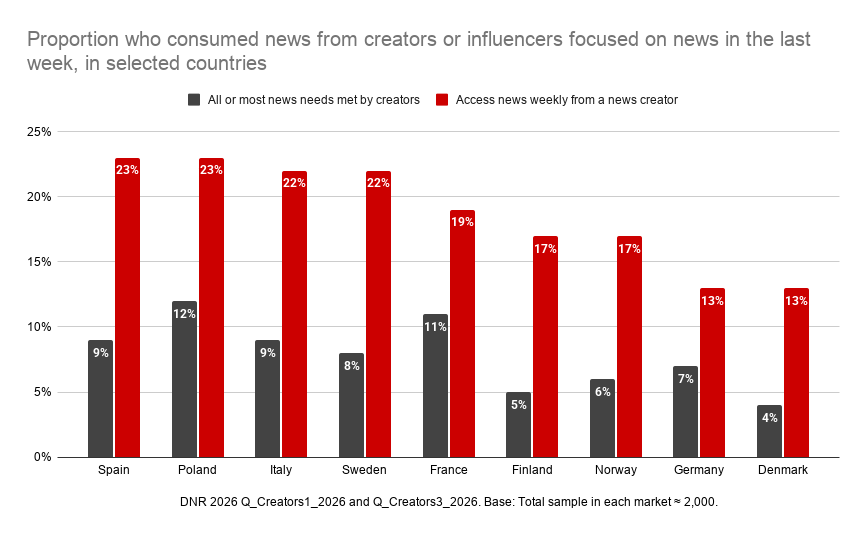
As creators’ influence grows, so does pressure to hold them accountable. Two recent European proposals illustrate this shift:
Denmark’s government plans to establish a media ombudsman to oversee influencers, bloggers, and podcasters outside the Press Council system, with powers to handle complaints about libel and slander (Digital News Report 2026, Denmark)
Spain is attempting to extend its classic media-law instrument — the right of reply and rectification — to large social media accounts. The government announed in January 2026 a bill that extends media rectification requests to influencers, “users of special relevance” with as low as 100,000 follower thresholds. The bill would allow citizens to request corrections also from high-reach influencers and online commentators. Under the proposal, qualifying influencers would have to provide a visible channel through which people can request a correction when factual claims about them are false or inaccurate and potentially harmful.
These examples show how national governments strive to gain some control of the rapidly changing information environment.
The ongoing EU regulatory revisions such as the revision of the Audiovisual Media Services Directive and updating consumer protections under the Digital Fairness act initiative will likely affect influencer content on video sharing platforms.
Influencer regulation and platform regulation are inseparable
The regulation of influencers is increasingly intertwined with platform governance. Recently, the most politically popular topic has obviously been the enforcement of age restrictions to prevent underage users logging in on social media platforms, and other measures compelling online platforms to keep children safe (Protecting children online).
While national age-limit proposals are accelerating in Europe (see ie. Denmark, Sweden, Finland), the EU is now treating ineffective age gates as a DSA enforcement issue (Commission preliminarily finds Meta in breach of Digital Services Act for failing to prevent minors under 13 from using Instagram and Facebook).
Which regulation initiatives do you think could have the biggest impact on the Nordic influencer landscape? I’d also be interested to hear your broader view: what kind of influencer regulation is needed—and where should the limits be?